
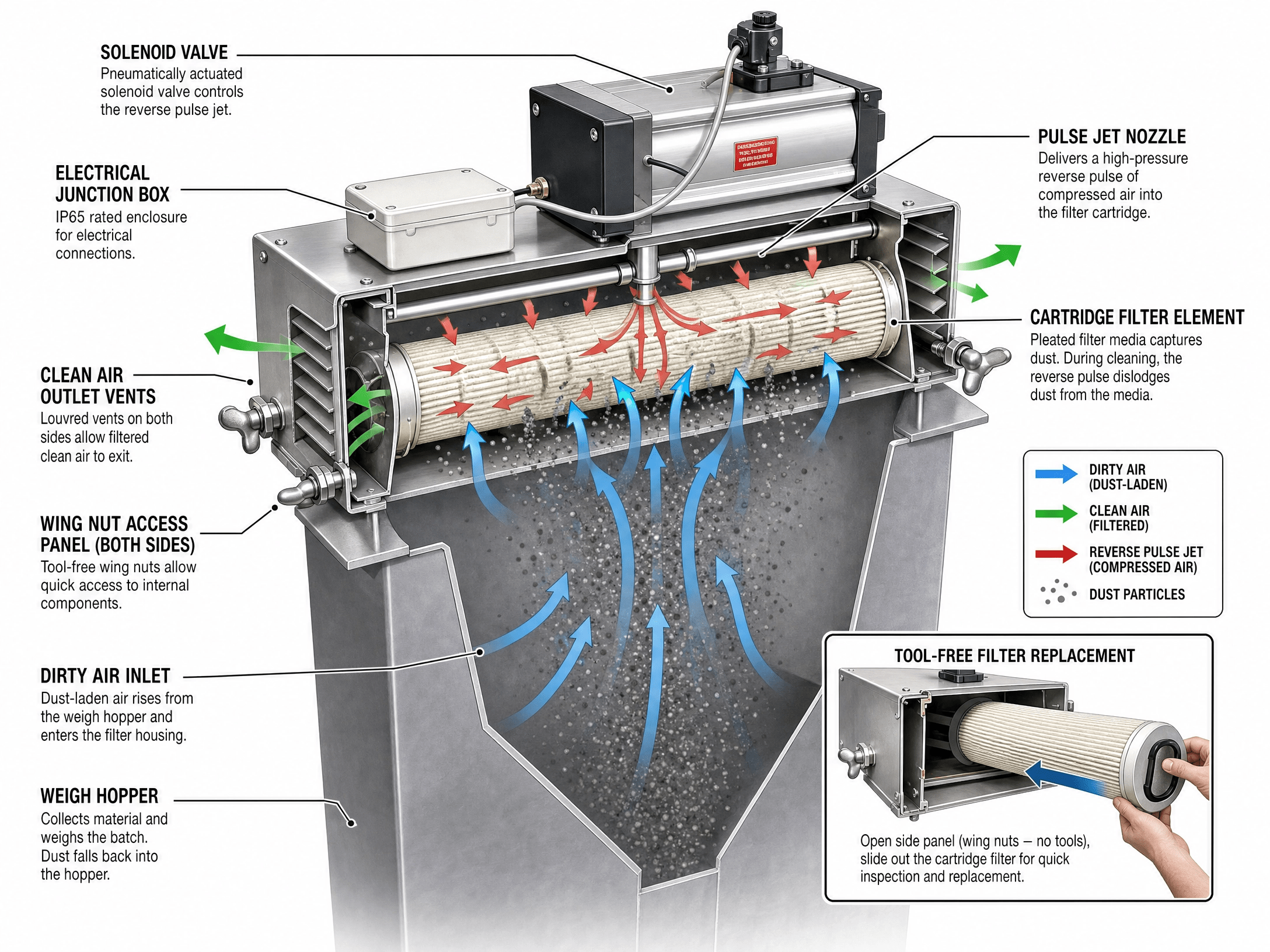
Dust is an unavoidable fact of life in a concrete batching plant. Every time cement or fly ash is pneumatically conveyed into a weigh hopper, fine particles escape and create a dusty, hazardous environment . Left unchecked, this dust poses health risks, damages equipment, and can land you in trouble with environmental regulators. The Hoppertop with reverse pulsator is the industry’s answer to this problem. This compact, cylindrical venting filter is specifically designed to fit on top of weigh hoppers where space is at a premium . It captures airborne dust, filters it to near-zero emissions, and automatically cleans itself using a reverse pulse of compressed air .
In this guide, we will explain what a Hoppertop with reverse pulsator is, how the reverse pulsator cleaning system works, why it is essential for your batching plant, and how to maintain it.
What Is a Hoppertop?
The Hoppertop is a compact, cylindrically shaped venting filter developed specifically for installation on weigh hoppers in concrete batching plants . It is designed for applications where installation space is limited, making it the perfect solution for retrofitting onto existing hoppers .
Unlike large, bulky baghouse dust collectors that require significant floor space, the Hoppertop mounts directly on top of the hopper. Its small footprint—just 0.06 square meters—means it takes up virtually no valuable plant real estate .
Inside the unit is a single WAM cartridge filter element that captures dust particles from the air displaced during hopper filling . The filtered air is released, and the captured dust drops back into the hopper, keeping material contained and preventing waste .
What Is a Reverse Pulsator?
The “reverse pulsator” refers to the automatic cleaning system integrated into the Hoppertop . This is what sets the Hoppertop apart from simple passive filters.
As the filter captures dust, a layer of material builds up on the surface of the cartridge element . If this layer is not removed, airflow becomes restricted, and the filter becomes ineffective. The reverse pulsator addresses this with an integrated compressed air pulse-jet cleaning system .
Here is how it works:
- A controller triggers a “Full-Immersion” solenoid valve that releases a short, powerful blast of compressed air—typically at 4 bar (58 psi) .
- This blast travels backwards through the filter element, in the reverse direction of normal airflow .
- The reverse pulse dislodges the accumulated dust cake from the outside surface of the filter .
- The dislodged dust drops back down into the weigh hopper below, ready to be used in the next batch .
This entire process is automatic and requires no manual intervention. It ensures the filter remains clean and efficient without interrupting production .
Why the Hoppertop Is Essential in Concrete Batching
The Hoppertop with reverse pulsator is not just a nice-to-have accessory. It is a critical component for several reasons:
1. Environmental Compliance
Cement dust is a regulated airborne pollutant. Without effective filtration, your plant could exceed legal emission limits, leading to fines and potential shutdowns. The Hoppertop features B.I.A.-certified filter media that achieves low emission levels .
2. Worker Health and Safety
Cement dust contains silica, which is hazardous when inhaled . A Hoppertop captures dust at the source, protecting your workers from respiratory illnesses and creating a cleaner, safer work environment.
3. Material Conservation
The dust captured by the Hoppertop is not wasted. It drops back into the weigh hopper and becomes part of the concrete mix. This conserves valuable material and saves you money .
4. Space Efficiency
Unlike baghouse collectors that require substantial floor space, the Hoppertop mounts directly on the hopper. Its compact design makes it ideal for plants with tight layouts or for retrofitting onto existing hoppers .
5. Regulatory Compliance
A properly maintained dust collection system is a regulatory requirement in many jurisdictions. The Hoppertop’s ability to meet stringent emission standards helps keep your plant compliant and operating without interruption .
Features of the Hoppertop
|
Feature |
Specification |
Why It Matters |
|
Filter Surface |
1.4 m² (15 sq ft) |
Provides efficient filtration in a compact package. |
|
Air Volume |
Up to 140 m³/h (82 cfm) |
Handles the typical airflow from a weigh hopper. |
|
Casing Material |
Stainless steel with bottom flange |
Corrosion-resistant and durable in harsh plant environments. |
|
Cleaning System |
Compressed air pulse-jet (4 bar) |
Automatic, self-cleaning design. |
|
Footprint |
0.06 m² (0.65 sq ft) |
Takes up minimal space. |
|
Filter Replacement |
Tool-free |
Easy maintenance with no specialized tools required. |
|
Weather Protection |
Hinged top cover |
Protects the filter from rain and weather when installed outdoors. |
Maintenance of a Hoppertop
A Hoppertop with reverse pulsator is designed to be low-maintenance, but some care is still required to ensure long-term performance.
Filter Element Replacement
The cartridge filter element should be replaced periodically. Signs that replacement is needed include:
- Increased pressure drop: The plant’s differential pressure gauge shows that airflow is becoming restricted even after cleaning cycles.
- Visible dust emissions: Dust is visible escaping from the top or sides of the unit, indicating a damaged or worn filter.
- Physical inspection: The filter appears torn, compressed, or heavily degraded.
Replacement is quick and requires no tools . Keep spare elements on hand to avoid extended downtime.
Compressed Air Checks
The cleaning system relies on clean, dry compressed air at the correct pressure . Ensure that:
- The compressor is delivering the required 4 bar (58 psi) .
- The air is filtered and free of moisture and oil to prevent damage to the solenoid valve and filter element.
- The solenoid valves are functioning correctly. A failed valve can waste compressed air and reduce cleaning efficiency .
The Bottom Line
The Hoppertop with reverse pulsator is a small investment that delivers significant returns. It keeps your weigh hopper dust-free, protects your workers and the environment, and ensures you stay compliant with emissions regulations.
Its compact design makes it suitable for any batching plant, whether new or retrofitted. And its automatic reverse pulsator cleaning system means it keeps working hard with minimal maintenance. Keep your filter elements clean and your compressed air supply dry, and your Hoppertop will serve you reliably for years to come.