In the world of concrete mixing, the efficiency and quality of your final product often come down to the specifics of your equipment. While the rotating drum is the star of the show, the components that guide materials into it, Cement Plant Feed Hoppers and the V-shute, play a crucial role in determining loading speed, mix consistency, and maintenance needs. Understanding the difference between these two critical parts of the material flow system is essential for any fleet manager or operator looking to optimize their concrete operations.
Nsimbi Engineering Solutions offers a range of high-quality feed hoppers (NES019-NES022) and V-shutes (NES023-NES027) for leading mixer truck brands. But which one is right for your application? This guide breaks down their functions, advantages, and ideal use cases.
What are Cement Plant Feed Hoppers?
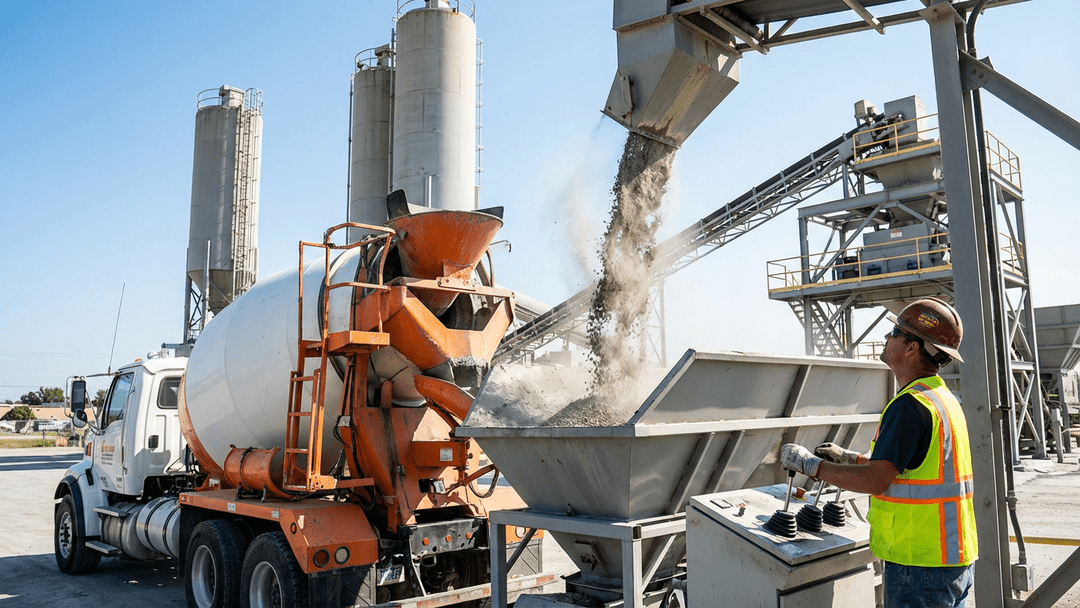
A feed hopper is a large, funnel-shaped component located at the rear of the mixer truck. Its primary function is to provide a wide opening to receive the raw materials—cement, aggregate, and sand—from the batching plant. The wide design minimizes spillage during loading, making it a clean and efficient option for high-volume operations.
Key Characteristics of Feed Hoppers:
- Wide Mouth: Reduces material loss during the loading process.
- Steep Angle: Encourages a smooth and rapid flow of materials into the drum.
- Durable Construction: Built to withstand the abrasive nature of raw aggregates.
Feed hoppers, like the NES020 Feed Hopper for Liebherr or the NES021 for Stetter, are ideal for operations where speed and minimizing waste are top priorities. They allow for rapid charging of the mixer drum, getting your trucks on the road faster.
What is a V-Shute?
A V-shute, as its name suggests, is a V-shaped channel that also directs materials into the mixer drum. However, it typically has a narrower profile compared to a cement plant feed hoppers. This design offers a more controlled flow of materials, which can be advantageous in specific situations.
Key Characteristics of V-Shutes:
- Controlled Flow: The narrower channel provides a more directed stream of materials.
- Reduced Dust: The controlled flow can help to minimize the amount of dust generated during loading.
- Versatility: V-shutes, such as the NES023 for FAW or the NES025 for Stetter, are often used in applications where precise loading is required.
Head-to-Head Comparison: Feed Hopper vs. V-Shute
| Feature | Feed Hopper | V‑Shute |
|---|---|---|
| Loading Speed | Faster, due to wider opening | Slower, more controlled |
| Spillage | Minimal, excellent containment | Higher risk of spillage if not aligned perfectly |
| Dust Control | Can generate more dust | Generally produces less dust |
| Blockages | Less prone to blockages with large aggregate | Can be more susceptible to blockages |
| Best For | High‑volume, rapid‑charging operations | Precision loading, dust‑sensitive environments |
Visualizing the Material Flow
Imagine a diagram showing a cross-section of a mixer truck. With a cement plant feed hoppers, the diagram would illustrate a wide cone channeling a large volume of material directly into the drum’s opening. The flow path is broad and less restricted.
Conversely, a diagram for a V-shute would show a more constricted, V-shaped path. This focuses the material into a tighter stream, which can be beneficial for ensuring all materials are properly introduced into the mixing blades at the back of the drum, but it can also create a bottleneck if the material flow from the batch plant is too high.
Maintenance and Longevity
Both feed hoppers and V-shutes are subject to significant abrasion. Over time, the constant flow of rock and sand will wear down the steel. Regular inspection for thinning walls, cracks, or holes is essential. A failure in either component can bring a truck offline and lead to costly repairs and material wastage.
Investing in high-quality, durable components from a trusted supplier like Nsimbi Engineering Solutions is critical. Their parts are designed to meet or exceed OEM specifications, ensuring a long service life and reliable performance for brands like TFM, ECEM, and Liebherr.
Conclusion: Making the Right Choice
The decision between a feed hopper and a V-shute depends on your operational priorities. If your primary goal is to load trucks as quickly as possible and minimize spillage at a high-volume batching plant, a feed hopper is likely the superior choice. If your operation requires more precise loading, operates in a dust-sensitive area, or deals with materials that are prone to creating dust clouds, a V-shute may be the better option.
Ultimately, the performance of your concrete mixer truck’s material flow system is a critical link in your production chain. Ensure you are using the right component for your needs and sourcing it from a supplier that guarantees quality and durability. Contact Nsimbi Engineering Solutions today to discuss your specific requirements and find the perfect feed hopper or V-shute for your fleet.