
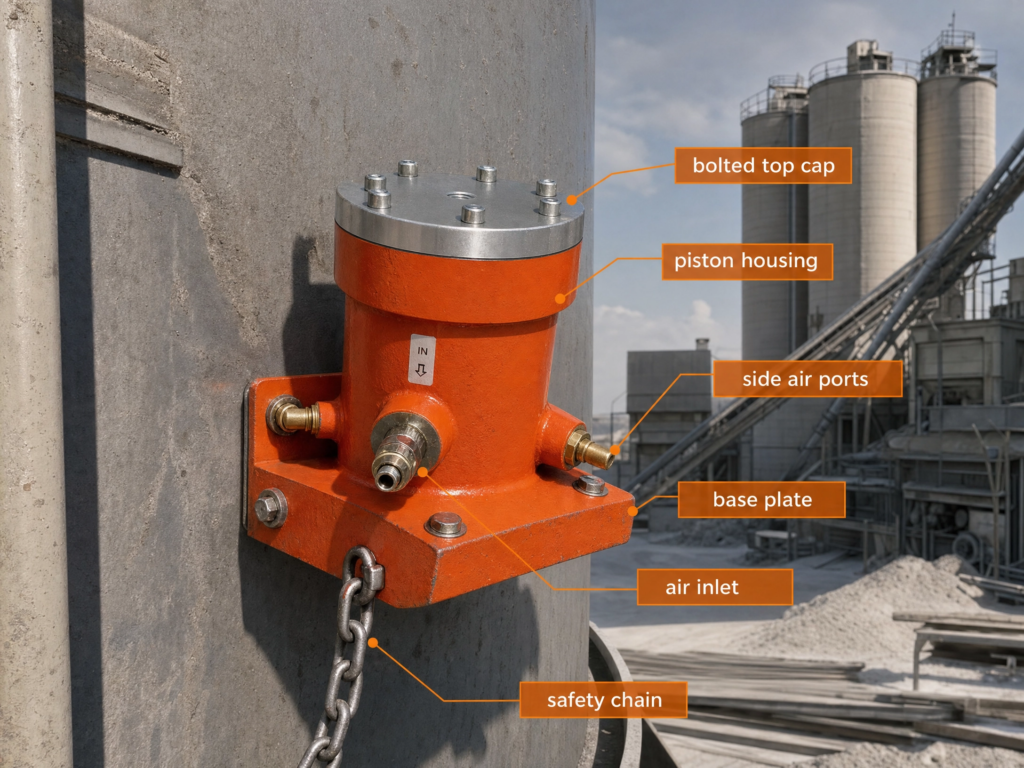
Few things are more frustrating in a concrete batching plant than a silo that refuses to discharge. The cement is in there—you know it is—but it has compacted, bridged, or formed a stubborn rat-hole that will not collapse. Enter the pneumatic hammer. This unassuming device, powered entirely by compressed air, delivers a powerful shockwave that dislodges compacted materials and restores flow in seconds . It is the unsung hero of bulk solids handling, and in a concrete batching plant, it is absolutely essential.
In this guide, we will explain exactly what a pneumatic hammer is, why it is critical for your batching plant, how to select the right one, and the maintenance practices that keep it performing for years.
What Is a Pneumatic Hammer?
A pneumatic hammer—also known as an air hammer, piston hammer, or flow aid—is a device mounted on the exterior surface of a silo, hopper, or chute that uses compressed air to generate a powerful impact force.
Inside the hammer, a piston is driven by compressed air. When the air pressure reaches a certain threshold, the piston is released and strikes a metallic base plate that is welded to the vessel wall. This impact transmits a violent shockwave through the wall, breaking up compacted material and restoring flow.
Unlike electric vibrators, a pneumatic hammer requires no electricity, generates no heat, and operates safely in explosive or dust-laden environments. This makes it the ideal solution for cement silos and aggregate bins where dust hazards are a constant concern.
Why Pneumatic Hammers Are Critical in Concrete Batching
Cement and other fine powders are notoriously difficult to handle. They compact under their own weight, they stick to walls when moisture is present, and they form arches and rat-holes that stop discharge entirely .
A properly installed pneumatic hammer addresses all of these challenges:
Bridging (Arching)
Material forms a solid arch across the outlet of a hopper, blocking all flow. The shockwave from the hammer collapses the arch, allowing material to discharge.
Rat-Holing
Material flows only through a narrow channel in the centre of the silo, leaving stagnant material stuck to the walls. Pneumatic hammers break up this stagnant material, restoring even flow .
Compaction
Over time, the weight of material in a silo compresses lower layers into a dense, stubborn mass. Regular impacts from pneumatic hammers prevent compaction from becoming a problem .
Wall Adhesion
When moisture is present, powders like cement stick to silo walls. Pneumatic hammers detach this adhered material.
How Pneumatic Hammers Compare to Other Flow Aids
Pneumatic hammers are not the only flow aids available. However, they occupy a specific niche that makes them uniquely suited for cement and concrete applications.
Pneumatic Hammer vs. Pneumatic Vibrator
Pneumatic vibrators generate a continuous, high-frequency vibration that shakes material loose . They are effective for free-flowing materials on chutes and screens. However, for heavy, compacted, or sticky powders in large silos, the high-impact shockwave of a pneumatic hammer is far more effective. Hammers are also generally more robust for heavy-duty applications.
Pneumatic Hammer vs. Electric Vibrator
Electric vibrators require electricity, which introduces spark and fire risks in dusty cement environments. Pneumatic hammers are inherently explosion-proof because they use only compressed air.
Pneumatic Hammer vs. Mechanical Agitators
Mechanical agitators (like paddle assemblies inside the hopper) are expensive, difficult to retrofit, and prone to wear from abrasive cement. Pneumatic hammers are simple, affordable, and can be retrofitted to existing silos without drilling.
Types of Pneumatic Hammers
There are two primary types of pneumatic hammers used in concrete batching plants:
1. Single Impact Hammer (Impact Type)
This is the most common type for silo and hopper applications. An internal piston is driven against a metallic base plate, delivering a single, powerful blow.
Examples: MARTSHOCK PS, Deca DAH Series
Best for: Breaking stubborn arches and rat-holes in large silos and hoppers.
2. Piston Type Hammer (Linear Impact Type)
This type delivers powerful, linear impacts in a piston-like action.
Example: San NTP Piston Type Hammer
Best for: Heavy-duty de-clogging where direct, mechanical blows are required.
3. Combined Hammer-Blast Type
This advanced type combines the mechanical impact of a hammer with a compressed air jet that expands across the wall surface .
Example: PICJET Combined Hammer Blast
Best for: Stubborn build-up where both impact and pneumatic cleaning are needed.
Selection Guide: Choosing the Right Pneumatic Hammer
Selecting the correct pneumatic hammer for your batching plant depends on several factors:
1. Material Characteristics
Fine, dry powders (cement, fly ash): Standard single impact hammers work well .
Sticky or damp materials: Piston-type or combined hammer-blast types may be more effective .
2. Silo or Hopper Size
Small hoppers: Smaller hammer sizes are sufficient.
Large silos: Larger hammers with higher impact energy are required.
3. Wall Thickness
Ensure the hammer’s impact energy is appropriate for your vessel’s wall thickness. Too much force can damage thin walls; too little will be ineffective. Deca’s product table, for example, matches hammer size to wall thickness.
4. Air Pressure and Consumption
Most pneumatic hammers operate between 3 and 6 bar (44 to 87 PSI) . Check the air consumption of the hammer against your plant’s compressed air capacity.
5. ATEX Compliance
If your plant handles explosive dust, ensure your hammers are ATEX-compliant for safe operation.
Proper Installation and Activation Sequence
Installation and operation require careful attention:
Installation
- Mounting plate: A mounting plate is welded to the vessel wall .
- No drilling required: Most models can be retrofitted without drilling holes in the silo.
- Safety chain: A safety chain prevents the hammer from falling during installation or maintenance.
Activation Sequence
When operating multiple hammers on a single silo, always activate them from bottom to top . This ensures material is discharged from the outlet first, preventing further compaction above.
Maintenance and Troubleshooting
Pneumatic hammers are generally low-maintenance, but some care is required:
Regular Checks
- Inspect mounting plates for signs of fatigue or cracking.
- Check air supply for adequate pressure and cleanliness (class 5.4.1 air quality is recommended) .
- Listen for unusual noises during operation. A hammer that sounds different may have a worn piston or internal component.
Lubrication
Many pneumatic hammers require lubricated air . Ensure your air supply includes an appropriate lubricator.
Replacement Indicators
While hammers are durable, they do have a finite service life. Some manufacturers offer warranties up to 150,000 impacts . Replace the hammer if impact force noticeably decreases or if the piston becomes worn.
The Bottom Line
A pneumatic hammer is a small investment that protects a much larger one: your continuous production. By preventing silo blockages, bridging, and rat-holing, these devices keep material flowing and your batching plant operating at full capacity.
Select the right type for your material and vessel, install it correctly with the proper activation sequence, and maintain it with regular inspections. Your cement will flow, your weigh batchers will fill on time, and your production will never skip a beat.